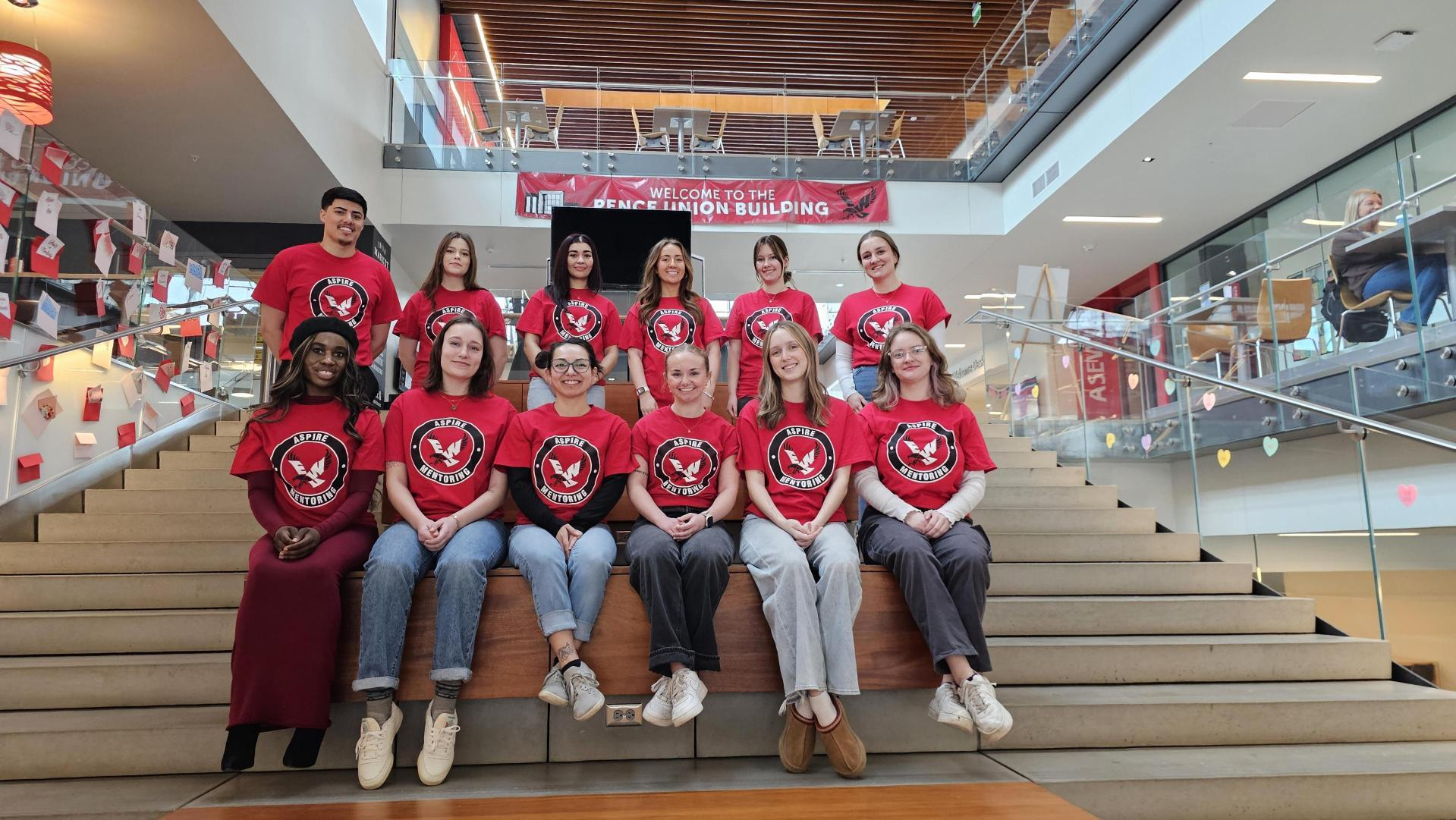
There’s nothing quite like mentorship. While family and friends certainly occupy a unique space in each of our lives, many people credit their educators, peers, and even supervisors as impactful figures who have changed lives.
Aspire Mentoring is relatively new to the mentoring scene, but they are already making waves. This near-peer mentoring program connects Eastern Washington University students with local high school students to make connections and share life skills.
In this interview, we met with the kind folks running Aspire Mentoring: Jasmin, Cecelia, and Emilio. They shared their mentorship philosophy and some of their favorite moments from the program. Read on to find out how Eags are supporting their community while learning a lesson or two themselves through the Aspire Mentoring program.
A Conversation With Aspire Mentoring
LAUNCHNW: Please introduce yourselves and tell us about who you are, what you enjoy outside of work, and then what your role is at Aspire.
JASMIN: I’ll start. I am Jasmin Davis, the Aspire Manager for the Aspire Near Peer Mentoring Program. Outside of work, I love to dabble in literally everything. But the things that take up most of my time is [being] Vice President for the Spokane Lilac Festival Association. We work with helping young high school seniors grow professionally, and I absolutely love that. And I’m also a big sucker for some cribbage.
EMILIO: I’m Emilio Ramos and I’m one of the Aspire Mentor Leads here. For my free time, I’d probably say it depends on the season. In summer, I’m bigger on golf, and then when football season comes around, I like to do that. During winter, I’ll coach (or just be involved in) wrestling. Big sports guy.
CECELIA: I am Cecelia DeLay and I am the other Aspire Mentor Lead. Outside of work, I am big on cooking, baking, and spending time with my friends, going on hikes with my husband, hanging out with my cat.
LAUNCHNW: What is Aspire and what do you all do?
JASMIN: Aspire is a near peer mentoring program where we connect Eastern [Washington University] students with local high school students. We help [those high school students] figure out a best fit pathway, whether it’s two-year, trade, apprenticeship, military. We provide them with all the different resources and information on those pathways. In addition, we help them with some life skills: resumes, cover letters, interviews, basic insurance– you name it, anything to set them up for whatever pathway they choose.

LAUNCHNW: So, really comprehensive then.
CECELIA: We try. A little bit about how our roles play into that: Emilio and I do a lot of curriculum planning with Jasmin. It’s just a little three-man team here, but we all have a kind of designated thing.
Emilio does a lot of the social media work, and then Jasmin keeps us all with our heads on and makes sure that we’re running smoothly. We develop curriculum and games to help give the students a general understanding. We lead meetings twice a week with our mentors to help train them for the week ahead, get them prepared so that they don’t go into the mentoring sessions blind.
LAUNCHNW: Yeah, you all are pretty small team! How long has Aspire been around?
JASMIN: Not that long. This is our second academic year. I got hired as the first person in November of 2022 to get the ball rolling, and we were in two schools in spring 2023.
LAUNCHNW: Let’s talk about near peer mentoring. Say I was in high school: near peer mentoring would mean that someone who’s in college would be mentoring me. What would you say are the benefits of near peer mentoring? What makes it special compared to other kinds of mentoring?
CECELIA: I think it’s beneficial because there’s not this big gap like, “Oh, they don’t get it. I’m in high school and it’s different now.” A lot of our mentors are either fresh out of high school or only a couple of years [removed], so they have real world experiences fresh in their brain.
[For example], they’re not applying [to] the old FAFSA– they just did the new version of it. There’s this connection that they can build because it’s near peer. And in a different sense, it’s not like peer to peer, where it’s a senior with a sophomore or something like that. That can almost feel like, “You’re my age, why are you bossing me around?” I think it’s that sweet spot of them getting that connection.
EMILIO: Yeah, I feel like it’s beneficial because they get to see a person who they might be in a few months. They see it’s possible to move away from home, go to college, and not feel too lost. A lot of people probably have family members telling them to do this, do that, but maybe if they have somebody that wasn’t family telling them and guiding them in a certain direction, it might be beneficial– just hearing it from someone different, if that makes sense.

LAUNCHNW: What does mentor training entail?
EMILIO: We have two mentoring sessions every week that are designed to provide the curriculum to our mentors so that once they go into schools the following week, they know how to use our curriculum [with] mentees to understand the topic we’re covering.
JASMIN: We don’t expect our mentors to come in with all this vast knowledge on like, how to interview, trades and apprenticeships, because they are going to Eastern, right? Why would they have to know all of that? And so, a lot of the mentor meetings are just giving them that information so they feel fully knowledgeable and equipped to talk to their mentees.
CECELIA: I’ll add a little bit, too. That first meeting of the week on Monday is usually Emilio, myself, and Jasmin introducing the week’s topic. [For example], this week we’re doing how to read a financial aid package. And then on Wednesday, we’d actually have one of our mentors lead the activity for the topic as if they were in front of their mentees. [It helps] the other mentors see different mentoring styles, and we iron out any of the kinks.
EMILIO: We’ll take their feedback. They can let us know, like, “I don’t think this will work with my mentees,” since they’re working with the mentees more directly than we are.
LAUNCHNW: Why Eastern Washington University specifically? What makes it special?
JASMIN: I love that question. A lot of the Eastern student profiles and demographics– they are these first gen students, they’ve kind of lived a similar experience to the target audience of the mentees, right? So, we’re looking for mentees who are first gen, who come from these diverse backgrounds, and the Eastern mentors have already lived that.
They’re able to relate to them a lot easier and get that firsthand tale of their experience.
LAUNCHNW: What kinds of mentoring styles have you all seen from your mentors?
CECELIA: I have a pretty good example of my mentors at University High School with their students. We have one group with a mentor that’s really quiet, so a lot of the times they’ll play the games, and they’re not super talkative, but you do see the connection and they’re always happy to be there.
It took a couple of extra weeks to actually feel that confidence with their mentor. She played the long game: she shows up, she’s happy, she’s bubbly. Now, the students are showing up, and maybe they focus more on the discussion of the topic versus the actual activity, whereas another group is rowdy, fun. They want to play the game, eat the snacks, yell. And their mentor is all about letting them do their thing, answering questions as they come up, and letting the activity kind of push all the information through the fun and games.
I’m thankful that our mentors know how to read the room. They are very good about being like, “Okay, this is what my mentees need. Let me apply it to the specific group.”

LAUNCHNW: We’ve talked a lot about the benefits for mentees, the fact that they get this knowledge, how to navigate these different systems. But what do you think mentors get out of this?
EMILIO: We see the mentors get professional development throughout the year. You especially notice it about halfway through the year, because when we first start at schools, it feels like they’re waiting for us to tell them [what to do]. And then as time goes on, you see them just take the lead. They’re growing, they’re improving, they’re understanding. They can do this by themselves. It’s not like we have to hold their hand the entire time.
That’s nice. And you see a lot of confidence build up. A good amount of our mentors want to work with people in some way, and you see their interactions with people improve throughout the time. It’s great.
CECELIA: And to add to that, I was a mentor last year, so I got all of the stuff about job interviews, resume, cover letter, and we were literally applying [that knowledge] in that moment. It was helping update my resume, doing mock interviews in a way that I’d never done them before, that sort of thing.
So it’s not just the mentees learning how to do this stuff. A lot of the mentors have never had this kind of training before, and they not only get the training, but [also] the skills to teach other people.
JASMIN: And, obviously, we haven’t been around a lot, but we have seen incredible retention and graduation rates with our mentors.
LAUNCHNW: That’s wonderful! So, Aspire is only in its second year. Where are we going in the future with this?
JASMIN: Right now, we’re working on developing the program before we spread out. Ideally, we would love to be in more high schools and develop a secondary curriculum for middle schools too; kind of not waiting until [students are] juniors to start having these conversations.

Cecelia, Jasmin, and Emilio
LAUNCHNW: Any favorite moments from the program so far?
CECELIA: I mean, this is going to sound kind of nerdy, but Emilio and I were to find an activity to teach students about insurance, which is kind of boring and hard to understand. Emilio handcrafted– well, not handcrafted but online-crafted– this beautiful board game and we collaborated on [the rules]: like how money got moved around, what the cards said, what punishments there were, and what insurance things the students needed to know.
JASMIN: For me, my favorite moments are with our mentors. I think what’s incredible is they’re this group of students who have never really met before. They’re from different majors. They’re not involved in the same other clubs and organizations. And just seeing the bond that they create through working this job together [is great]. We have one who will be doing a symposium next week, and then our group is doing the symposium as well, and they’re so excited to take shifts of doing their tabling and going and seeing hers and supporting her showcase. Seeing those relationships being built between our mentors is what gets me.
LAUNCHNW: What would you tell a potential mentee or mentor, someone who’s considering the program?
JASMIN: It’s not as hard as you think. It’s about relationships and developing friendships.
CECELIA: My first thing was it’s connection over curriculum. We always say, “We’re not going to fire you if we hear you talking about what it looks like to live in a dorm instead of what to wear to a job interview.” I would say come into it with an open mind, whether you’re a mentor or mentee. The desire to learn is important because you’ll learn something no matter what.
EMILIO: I’ll say it’s more beneficial than you might think to be a mentor or a mentee, either one. There’s a benefit to both of them.
LAUNCHNW: Is there anything else you all want to talk about before we finish up here?
CECELIA: I want to add just a little bit about “Why Eastern?” Eastern is doing a lot to drive and commit to a more community-engaged mindset. We’re seeing that blossom into this servant-minded [perspective, asking] “How can our university be a part of the community?”
I think being a part of Aspire and having mentors embodies that. It’s part of what makes Aspire and Eastern mesh well together.
JASMIN: I’d like to say that we couldn’t have done this without all the people and organizations we partner with. The schools we’re working with, Big Brothers Big Sisters, Communities In Schools, ESD 101 and even [those] within the school, like the counselors and the principals. We couldn’t be doing that and making that same kind of impact if we didn’t have these partners.