Spokane Riverkeeper is a local nonprofit organization dedicated to protecting, preserving, and restoring the Spokane River for future generations. They envision a Spokane River where wild native fish thrive in the basin, pollution is eliminated, and the community is engaged in the River’s protection.
Recently, Jule Schultz, Waterkeeper at Spokane Riverkeeper, volunteered with Washington Alliance for Better Schools’ STEM4Good program which LaunchNW helps facilitate in Spokane. STEM4Good is a program dedicated to bringing free afterschool STEM programming to local elementary school students with the help of community volunteers, like Jule.
In this interview, LaunchNW followed up with Jule to learn more about his experience with STEM4Good and how his background with Spokane Riverkeeper contributed to the teaching process.
A Conversation With Jule Schultz
LaunchNW: Can you tell us a little bit about why you chose to do STEM4Good in the context of your mission as an organization?
JULE SCHULTZ: I think there’s a couple of reasons. Education is the path forward when it comes to connecting people to a cause. When I saw that STEM4Good had a lesson on salmon, I jumped on the opportunity. Salmon are being reintroduced into the Spokane River and even though we’re not directly involved in that project, it’s near and dear to my heart. We used to have upwards of a million anadromous (fish that go to the ocean and spawn) return to our river. The Coeur d’Alene, Spokane, and Colville Tribes have worked super hard figuring out a way to introduce anadromous fish into the river.
That’s great.
So, when I’m able to tell this sort of story to people that I think will grow up and maybe even enter an environmental field that could further this cause, I jump at the opportunity– not only because it’s so neat, but it also helps further our mission, right? The salmon need clean water, and our mission is to protect clean water and engage people with the river. And [STEM4Good] is something that we can do with this message, and it’s somewhat selfish [laughs]–
No, no, I don’t think so at all. That’s education and such specialized information in an area that kids normally don’t have access to, so you being there is incredible for them, really.
Right, and this is an emerging story! It’s not in the science textbooks yet. [There’s this] power to bring current scientific information and use it to fix a problem, too. We need to start thinking about how we’re going to get salmon across and over the dam and downstream because they’re releasing hundreds of thousands of smolts into our river to out-migrate baby salmon and then they’ll swim back as adults.
I really like the point you brought up about this being current science, because often a child goes to school and learns things, but it’s already been calcified, set in stone. This kind of opportunity provided by you and STEM4Good lets them experience emergent science, what’s right around the corner, and on top of that, it’s something they can see in their own community. That’s amazing.
Absolutely, and to connect that with my mission, the Spokane Riverkeeper mission, is a special opportunity.
You know, another reason that I participated in this is because I do think there should be an educational arm of Spokane Riverkeeper. We work with students a lot, but I’m not an educator and we’re being asked to educate quite often. So, dipping my toe into these waters gives me an opportunity to figure out how we could structure that with Spokane Riverkeeper. What would we want to do? Is this a lesson we can teach? Is this a school we can work with? Is there a connection that we need to make that happen?
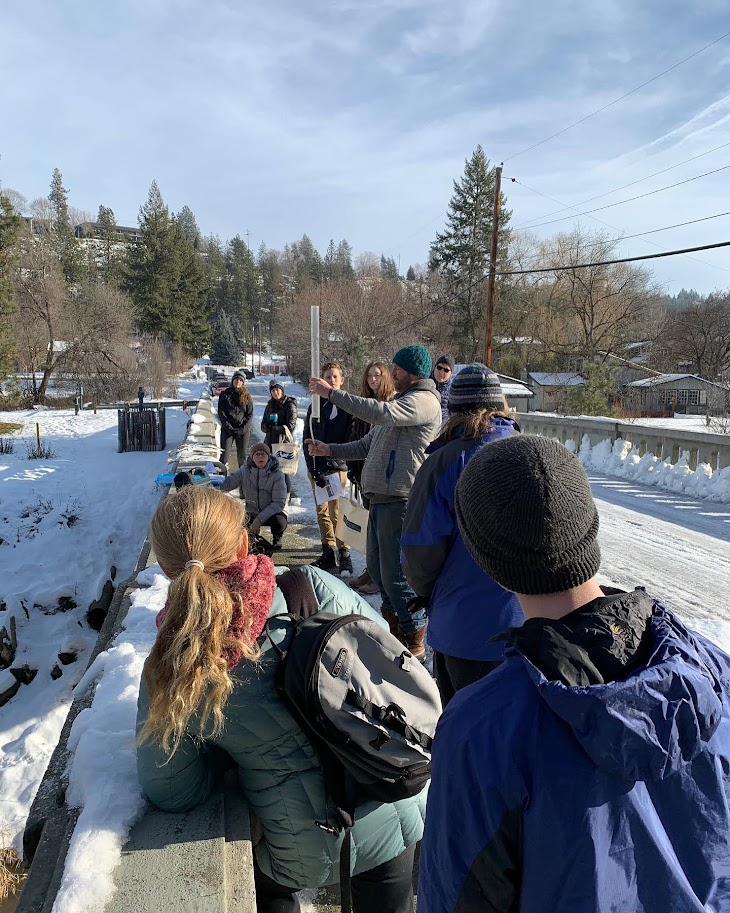
Well, you say you’re not an educator, but I thought you did pretty darn well in that class. The kids were all pretty engaged. It was great.
I was really lucky. STEM4Good does a good job providing the idea and the slides. I wish they had provided a more detailed explanation of what we were supposed to do, but that ended up being part of the fun. It turned out to be a really cool exercise.
What did it feel like to help guide students through those concepts and watch their understanding grow?
It started with this great foundation that the slides provided, and [the students] sort of got the concept, and then you jump into something on the table, and they have to figure it out. It was frustrating for them at first, and that was part of their journey. But then you can see it clicks. They’re able to pull knowledge from what they heard previously [in the slides and lesson].
It’s neat to see that click and that learning transfer over. The experiential learning is really neat. A lot of these students finished and were able to connect that to their real-life experience, take that to the next level, and really understand it.
STEM4Good is offered in partnership with Spokane Public Schools and Washington Alliance for Better Schools. It runs three sessions each year with rotating topics (one of which was the salmon!) across a wide range of STEM fields. Knowing that, would you be interested in volunteering again for a future topic?
Yeah, I would! I absolutely would. It was really rewarding, and because it was salmon, I felt like I had something extra to give.
I often dream of having something similar to what they did here with STEM4Good with things that Spokane Riverkeeper needs to solve: trash on the river, pollution in the river. We have a unique opportunity in Spokane to use the river as an educational tool, and although some people are doing that [already] in isolated areas, it’s still not being done to an extent that really takes full advantage of the river and gives the students a complete understanding of it. It’s a resource that’s underutilized and that we should know more about.

The Spokane Riverkeeper Team, from left to right: Katherine Thompson, Managing Director; Jule Schultz, Waterkeeper; Liv Kindl, River Cleanup & Outreach Lead; Katelyn Scott, Water Protector.
If someone is reading this and thinking, “This seems really cool, but I’m not sure if I have the time or a STEM background,” what would you say to them about the value of just showing up and volunteering?
Yeah, they’ve made it so simple that you don’t need a STEM background. The resources they provide, the PowerPoints and toolkits, are more than sufficient to teach these lessons. You’ll learn something yourself, but you’ll also be able to teach the students and guide them through a learning process.
I wouldn’t be worried if I wasn’t an educator or [didn’t have] a background in STEM. I think you should just go for it.
Sweet. Anything else you want to say?
I think it was a really great opportunity. I would love to be able to do it again. I appreciate it.